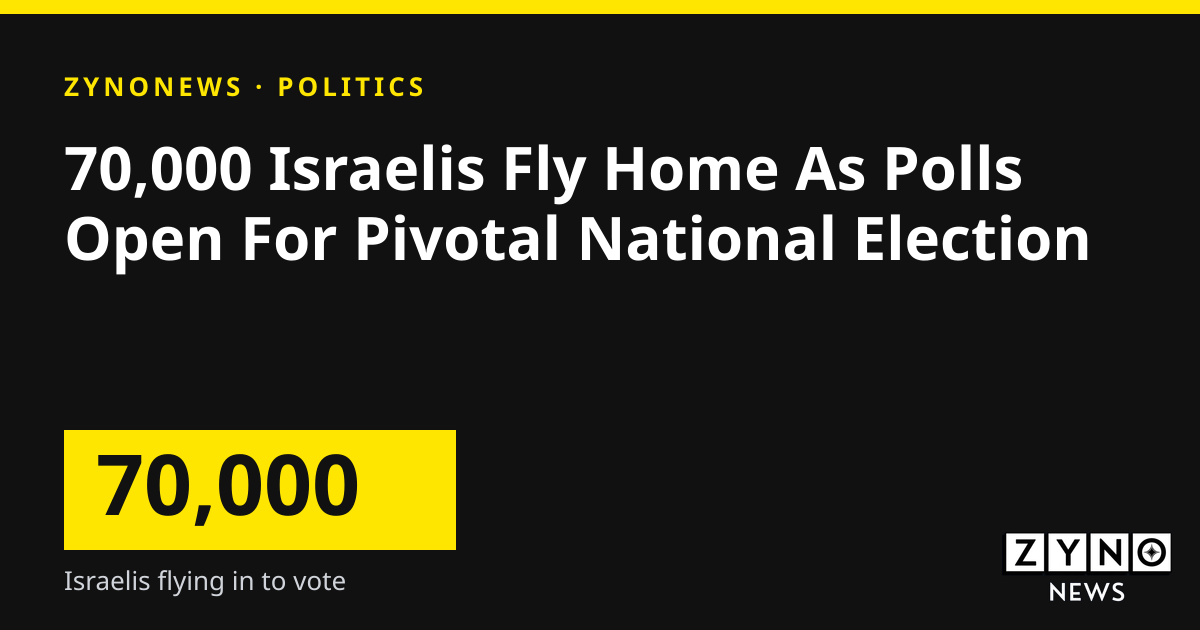
70,000 70,000 Israelis Fly Home As Polls Open For Pivotal National Election
Israelis cast ballots in a crucial national election on Tuesday, October 27, 2026, amid deep political divisions.
At a glance
- Polls opened on Tuesday, October 27, 2026, for Israel's national election.
- Approximately 70,000 Israelis living abroad were reportedly flying in to vote in the election.
- About half a million first-time voters were eligible to cast ballots in the election.
- Next: Votes are being cast to determine the outcome of the national election and government formation in the 120-member parliament.
Drafted with AI from named sources and checked automatically; published by our AI editor after passing every check. How briefs are made
- France 24
- BBC Middle East
- Prothom Alo English
- BBC World
- The Guardian World
The story
Polls opened on Tuesday, October 27, 2026, for Israel's national election as approximately 70,000 Israelis living abroad flew in to vote. About half a million first-time voters were eligible to cast ballots in the election.
A total of 61 seats are needed for a majority in Israel's 120-member parliament. Around 21 percent of Israel's population is Arab, and the country's real GDP growth reached 3.5% in 2025.
Opposition leader Gadi Eisenkot said the elections are primarily about the identity of the State of Israel. Meanwhile, supporter Shlomi Basher argued that Prime Minister Benjamin Netanyahu needs to be re-elected to finish his work.
What each side says
Opposition
“These elections are about many issues... They are about security, economy, education...but primarily, they are about the identity of the State of Israel, and what kind of Israel we want”Gadi Eisenkot
Supporters of Netanyahu
“If the army had woken him in time, it wouldn't have happened. He does bear a certain responsibility, but after the 7 October, he changed the entire Middle East.”Shlomi Basher
Who is involved
Gadi Eisenkot
Leader of the Yashar party and former military chief of staffIn this storyGadi Eisenkot stated that the elections are about security, economy, education, and primarily the identity of the State of Israel3.
How we got here
- 2026-10-27Polls opened for Israel's national election.
What the research says
This literature review provides an academic overview of the historical background and political context surrounding the legislative elections held in Israel on October 27, 2026. The review synthesizes official background materials and reports detailing the political parties, demographic factors, and electoral mechanics that shape the current governing coalition. The structure moves chronologically from early political history to contemporary party alliances and demographic participation, offering students and researchers a foundational synthesis of documented sources prior to today's vote.
Historical Foundations and Leadership
According to Wikipedia's history of Likud4, the major right-wing political party was founded in 1973 by Menachem Begin and Ariel Sharon, achieving a landslide victory in 1977 that marked the first time the left lost power in Israel. Likud leader Benjamin Netanyahu has served as Israel's prime minister on and off for more than 19 years, holding office from 1996 to 1999, from 2009 to 2021, and continuing since 2022, making him Israel's longest-serving prime minister according to Wikipedia's background on Benjamin Netanyahu5 and reports on the prime minister's tenure6.
Wikipedia's history of Likud4 notes that Netanyahu's first government fell apart after a vote of no confidence following Yitzhak Rabin's assassination, leading to elections in 1999 where Likud lost power.
Electoral Framework and Demographics
Legislative elections are held to elect all 120 members of the 26th Knesset and determine the governing coalition succeeding the 37th government led by Prime Minister Benjamin Netanyahu, as outlined in Wikipedia's overview of the 2026 Israeli legislative election7. A total of 61 seats are needed for a majority in the 120-member parliament, according to election reports6.
Electoral participation involves diverse demographic groups, with reports noting that approximately 70,000 Israelis living abroad flew in to vote3, about half a million first-time voters were eligible to cast ballots3, and around 21 percent of Israel's population is Arab6.
Contemporary Party Alliances
Recent political developments include the formation of new alliances for the legislative election. According to Wikipedia's background on Together (Israel)8, the political alliance was founded in April 2026 by former prime ministers Naftali Bennett and Yair Lapid, uniting their parties Bennett 2026 and Yesh Atid to run in the election with Bennett as its leader.
Additionally, reports identify Gadi Eisenkot as the leader of the centrist Yashar party and a former military chief of staff3. These political formations interact with broader security contexts, including the October 7, 2023, Hamas-led attacks, which resulted in nearly 1,200 deaths and 251 hostages taken, as documented in election reports3.
The reviewed literature documents the structural rules of the Knesset, historical election outcomes, and the formation of recent political alliances. However, the evidence does not yet show final voter turnout percentages, the distribution of votes among the 120 Knesset seats, or the ultimate composition of the governing coalition that will succeed the 37th government. Additionally, while demographic figures such as the Arab population percentage and the number of first-time voters are provided, the literature lacks detailed breakdowns of voting behavior across specific demographic subgroups.
What to watch
- Votes are being cast to determine the outcome of the national election and government formation in the 120-member parliament.
Update to an ongoing story. Follow this story over time: How Will Israel's First Post-Attack Parliamentary Elections Shape the Future Government? — living research page →
The data
Real GDP Growth Ranking
Israel: 3.5%, 102 of 195 countries (median 3.5%).
IMF World Economic OutlookDownload data (CSV, opens in Excel)
Show the numbers (195)
Indicator: real GDP growth · Year: 2025 · Source: IMF World Economic Outlook
| Rank | Country | Value |
|---|---|---|
| 1 | South Sudan | 41.4 |
| 2 | Guyana | 19.3 |
| 3 | Libya | 15.9 |
| 4 | Kyrgyzstan | 11.1 |
| 5 | Rwanda | 9.4 |
| 6 | Ethiopia | 9.2 |
| 7 | Venezuela | 9 |
| 8 | Taiwan Province of China | 8.8 |
| 9 | Tajikistan | 8.4 |
| 10 | Zimbabwe | 8.3 |
| 11 | Bhutan | 8.2 |
| 12 | Benin | 8.1 |
| 13 | Ireland | 8 |
| 14 | Vietnam | 8 |
| 15 | India | 7.8 |
| 16 | Uzbekistan | 7.7 |
| 17 | Georgia | 7.5 |
| 18 | Armenia | 7.1 |
| 19 | Guinea | 6.9 |
| 20 | Niger | 6.9 |
| 21 | Mongolia | 6.8 |
| 22 | Senegal | 6.7 |
| 23 | Uganda | 6.7 |
| 24 | Paraguay | 6.6 |
| 25 | Côte d'Ivoire | 6.5 |
| 26 | Kazakhstan | 6.5 |
| 27 | Aruba | 6.3 |
| 28 | Cabo Verde | 6.3 |
| 29 | Maldives | 6.3 |
| 30 | Togo | 6.3 |
| 31 | Papua New Guinea | 6.2 |
| 32 | United Arab Emirates | 6.2 |
| 33 | Ghana | 6 |
| 34 | Palau | 6 |
| 35 | Tanzania | 5.9 |
| 36 | Central African Republic | 5.8 |
| 37 | Guinea-Bissau | 5.8 |
| 38 | Seychelles | 5.8 |
| 39 | Democratic Republic of the Congo | 5.7 |
| 40 | The Gambia | 5.7 |
| 41 | Burkina Faso | 5.3 |
| 42 | Cambodia | 5.3 |
| 43 | Malaysia | 5.2 |
| 44 | Tuvalu | 5.2 |
| 45 | Chad | 5.1 |
| 46 | Indonesia | 5.1 |
| 47 | Liberia | 5.1 |
| 48 | China | 5 |
| 49 | Singapore | 5 |
| 50 | Sri Lanka | 5 |
| 51 | Djibouti | 4.9 |
| 52 | Eswatini | 4.9 |
| 53 | Mali | 4.9 |
| 54 | Morocco | 4.9 |
| 55 | Nicaragua | 4.9 |
| 56 | Grenada | 4.8 |
| 57 | Laos | 4.8 |
| 58 | Sierra Leone | 4.8 |
| 59 | Macao SAR | 4.7 |
| 60 | Malta | 4.7 |
… 135 more rows in the CSV
Inflation
Israel: 3% in 2025 (-0.1 pts from 2024).
dashed = IMF forecastIMF World Economic OutlookDownload data (CSV, opens in Excel)
Show the numbers (31)
Country: Israel · Indicator: inflation · Source: IMF World Economic Outlook
| Year | Value | Forecast |
|---|---|---|
| 2001 | 1.1 | no |
| 2002 | 5.7 | no |
| 2003 | 0.7 | no |
| 2004 | -0.4 | no |
| 2005 | 1.3 | no |
| 2006 | 2.1 | no |
| 2007 | 0.5 | no |
| 2008 | 4.6 | no |
| 2009 | 3.3 | no |
| 2010 | 2.7 | no |
| 2011 | 3.5 | no |
| 2012 | 1.7 | no |
| 2013 | 1.5 | no |
| 2014 | 0.5 | no |
| 2015 | -0.6 | no |
| 2016 | -0.5 | no |
| 2017 | 0.2 | no |
| 2018 | 0.8 | no |
| 2019 | 0.8 | no |
| 2020 | -0.6 | no |
| 2021 | 1.5 | no |
| 2022 | 4.4 | no |
| 2023 | 4.2 | no |
| 2024 | 3.1 | no |
| 2025 | 3 | no |
| 2026 | 1.8 | yes |
| 2027 | 2 | yes |
| 2028 | 2 | yes |
| 2029 | 2 | yes |
| 2030 | 2 | yes |
| 2031 | 2 | yes |
IMF World Economic Outlook (IMF data, reused with citation)
Background
At a glance
 Israel
- Capital
- Jerusalem
- Population
- 10.1 million
- Leaders
- Isaac Herzog · Benjamin Netanyahu
- Currency
- new shekel
Wikidata · IMF, 2026-10-27
Sources and method
References (15)
News reports
- Deeply divided Israel braces for pivotal election BBC Middle East
- Israel to give verdict on Netanyahu in pivotal election Prothom Alo English
Background
- Gadi Eisenkot Wikipedia
- Gadi Eisenkot (Wikidata) Wikidata
- Likud Wikipedia
- Benjamin Netanyahu Wikipedia
- 2026 Israeli legislative election Wikipedia
- Together (Israel) Wikipedia
Reports used for this brief
- Polls open in Israeli election seen as referendum on Netanyahu France 24
- Deeply divided Israel braces for pivotal election BBC Middle East
- Israel to give verdict on Netanyahu in pivotal election Prothom Alo English
- Why Israel's election is one of the most important in its history BBC World
- Israel election live: polls open in most consequential vote in country’s history The Guardian World
Data
- IMF World Economic Outlook IMF data, reused with citation
- World Bank, World Development Indicators CC BY 4.0
How this brief was made
Automated research by ZynoNews: trending topic detected across news, searches and Wikipedia; facts and statements from the reports listed; numbers computed from open data; checked automatically for numbers, sources, copying and neutrality. Version 1. 5 news reports from 5 outlets, 4 official datasets, 0 research studies and 6 background sources.
Cite this
For papers, reports and theses. ZynoNews articles keep their address; updates are listed with their date.
ZynoNews Desk. (2026, October 28). 70,000 Israelis Fly Home As Polls Open For Pivotal National Election. ZynoNews. https://zynonews.org/news/70-000-israelis-fly-home-as-polls-open-for-pivotal-national-election-68ee86