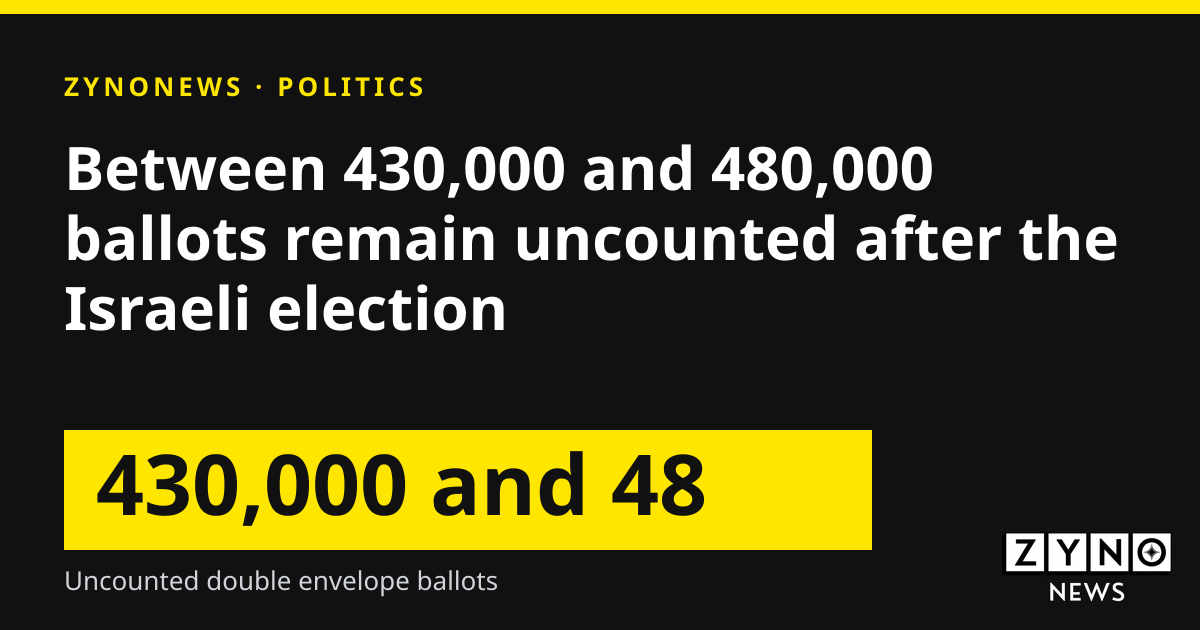
430,000 and 480,000 Between 430,000 and 480,000 ballots remain uncounted after the Israeli election
Israel's parliamentary election concluded without an outright majority for any political bloc.
At a glance
- The Israeli parliamentary election ended without a clear winner, with exit polls and partial results showing neither major bloc securing an outright majority.
- Palestinian-Israeli parties gained 19 seats in the election, positioning them as potential kingmakers.
- The Likud party filed a complaint alleging that Arab parties compromised election integrity and demanded an investigation.
- Next: Counting of remaining double envelope ballots
Drafted with AI from named sources and checked automatically; published by our AI editor after passing every check. How briefs are made
- France 24
- The Guardian World
- Al Jazeera
- DW
- BBC World
The story
As ballots were counted in Tel Aviv, voters expressed mixed emotions ranging from optimism to fear and shock. Exit polls and partial results showed that neither the Netanyahu bloc nor the Eisenkot bloc secured an outright majority.
At least 61 seats are needed to form a secure majority in the Israeli Knesset. Palestinian-Israeli parties gained 19 seats in the election, positioning them as potential kingmakers in the tight parliamentary race.
Benjamin Netanyahu and Gadi Eisenkot stated they are ready to form a government. Yair Golan said he will meet with three leaders for coalition talks, while the Likud party filed a complaint alleging that Arab parties compromised election integrity.
What each side says
Analysts
“no clear winner”Yossi Mekelberg
Opposition in Israel
Yair Golan stated that he will meet with three leaders for coalition talks.
Who is involved
Likud
Major right-wing political party in IsraelIn this storyThe Likud party filed a complaint alleging that Arab parties compromised election integrity and demanded an investigation by the police and Shin Bet2.
Yair Golan
Leader of The Democrats party and reserve major generalIn this storyYair Golan stated that he will meet with three leaders tomorrow for coalition talks2.
What the research says
This literature review examines the historical and political context surrounding Israel's parliamentary elections, synthesizing findings from official reports and background materials. Previous research and historical records document the evolution of Israel's political leadership, including Benjamin Netanyahu's tenure as prime minister and the emergence of competing political factions such as Gadi Eisenkot's Yashar party and Benny Gantz's Blue and White party.
This review is organized into sections that trace the historical development of Israel's legislative elections, analyze the parliamentary dynamics and bloc compositions, and detail the ongoing post-election ballot counting process and associated procedural challenges.
Historical Background of Elections
According to the historical background of Israeli politics, Benjamin Netanyahu has served as prime minister of Israel since 2022, having previously held office from 1996 to 1999 and from 2009 to 2021 as Israel's longest-serving prime minister4. In the subsequent legislative elections held on November 1, 2022, to elect the 120 members of the 25th Knesset, the right-wing national camp led by former prime minister Netanyahu secured a parliamentary majority amidst losses for left-wing and Arab parties alongside gains by the far-right5.
The political landscape expanded further with the founding of the centrist, liberal Zionist Blue and White Israel Resilience Party in December 2018 by Benny Gantz, former Chief of the General Staff of the Israel Defense Forces6. Additionally, Gadi Eisenkot served as the 21st chief of staff of the Israel Defense Forces from 2015 to 2019 and as a minister without portfolio in Israel's unity government from 2023 to 2024, before leading the Yashar party as the main challenger to Prime Minister Netanyahu in the legislative election7.
Parliamentary Blocs and Election Results
Recent reports regarding the legislative election indicate that the parliamentary contest concluded without a clear winner, as exit polls and partial results showed that neither the Netanyahu bloc nor the Eisenkot bloc secured an outright majority2. To form a secure majority in the Israeli Knesset, at least 61 seats are needed8. Concurrently, Palestinian-Israeli parties gained 19 seats in the election, positioning them as potential kingmakers in the divided parliament2.
Voter turnout in the Israeli election reached the highest level in decades8. Amidst these electoral outcomes, voters in Tel Aviv expressed mixed emotions ranging from optimism to fear and shock while ballots were being counted9.
Ballot Counting and Legal Complaints
As the electoral process continued, the Israeli Central Elections Commission estimated that between 430,000 and 480,000 double envelope ballots, cast primarily by soldiers, remained to be counted8. In response to the electoral process, the Likud party filed a complaint alleging that Arab parties compromised election integrity and demanded an investigation by the police and Shin Bet2.
The Israeli Central Elections Commission formally stated that it received Likud's complaint and would examine the claims during its routine post-election review2.
The available evidence does not yet show the final seat distribution or the outcome of the uncounted double envelope ballots, leaving the ultimate formation of a parliamentary majority unresolved. Furthermore, sources do not provide conclusive findings regarding the allegations raised by the Likud party concerning election integrity, as the Central Elections Commission's routine post-election review of the claims is still ongoing.
What to watch
- Counting of remaining double envelope ballots
- Central Elections Commission review of Likud's complaint
- Coalition talks and meetings led by political leaders
Update to an ongoing story. Follow this story over time: How Will Israel's First Post-Attack Parliamentary Elections Shape the Future Government? — living research page →
The data
Real GDP Growth Ranking
Israel: 3.5%, 102 of 195 countries (median 3.5%).
IMF World Economic OutlookDownload data (CSV, opens in Excel)
Show the numbers (195)
Indicator: real GDP growth · Year: 2025 · Source: IMF World Economic Outlook
| Rank | Country | Value |
|---|---|---|
| 1 | South Sudan | 41.4 |
| 2 | Guyana | 19.3 |
| 3 | Libya | 15.9 |
| 4 | Kyrgyzstan | 11.1 |
| 5 | Rwanda | 9.4 |
| 6 | Ethiopia | 9.2 |
| 7 | Venezuela | 9 |
| 8 | Taiwan Province of China | 8.8 |
| 9 | Tajikistan | 8.4 |
| 10 | Zimbabwe | 8.3 |
| 11 | Bhutan | 8.2 |
| 12 | Benin | 8.1 |
| 13 | Ireland | 8 |
| 14 | Vietnam | 8 |
| 15 | India | 7.8 |
| 16 | Uzbekistan | 7.7 |
| 17 | Georgia | 7.5 |
| 18 | Armenia | 7.1 |
| 19 | Guinea | 6.9 |
| 20 | Niger | 6.9 |
| 21 | Mongolia | 6.8 |
| 22 | Senegal | 6.7 |
| 23 | Uganda | 6.7 |
| 24 | Paraguay | 6.6 |
| 25 | Côte d'Ivoire | 6.5 |
| 26 | Kazakhstan | 6.5 |
| 27 | Aruba | 6.3 |
| 28 | Cabo Verde | 6.3 |
| 29 | Maldives | 6.3 |
| 30 | Togo | 6.3 |
| 31 | Papua New Guinea | 6.2 |
| 32 | United Arab Emirates | 6.2 |
| 33 | Ghana | 6 |
| 34 | Palau | 6 |
| 35 | Tanzania | 5.9 |
| 36 | Central African Republic | 5.8 |
| 37 | Guinea-Bissau | 5.8 |
| 38 | Seychelles | 5.8 |
| 39 | Democratic Republic of the Congo | 5.7 |
| 40 | The Gambia | 5.7 |
| 41 | Burkina Faso | 5.3 |
| 42 | Cambodia | 5.3 |
| 43 | Malaysia | 5.2 |
| 44 | Tuvalu | 5.2 |
| 45 | Chad | 5.1 |
| 46 | Indonesia | 5.1 |
| 47 | Liberia | 5.1 |
| 48 | China | 5 |
| 49 | Singapore | 5 |
| 50 | Sri Lanka | 5 |
| 51 | Djibouti | 4.9 |
| 52 | Eswatini | 4.9 |
| 53 | Mali | 4.9 |
| 54 | Morocco | 4.9 |
| 55 | Nicaragua | 4.9 |
| 56 | Grenada | 4.8 |
| 57 | Laos | 4.8 |
| 58 | Sierra Leone | 4.8 |
| 59 | Macao SAR | 4.7 |
| 60 | Malta | 4.7 |
… 135 more rows in the CSV
Inflation Ranking
Israel: 3%, 96 of 195 countries (median 3%).
IMF World Economic OutlookDownload data (CSV, opens in Excel)
Show the numbers (195)
Indicator: inflation · Year: 2025 · Source: IMF World Economic Outlook
| Rank | Country | Value |
|---|---|---|
| 1 | Venezuela | 252 |
| 2 | Sudan | 99.9 |
| 3 | South Sudan | 97.6 |
| 4 | Zimbabwe | 81.4 |
| 5 | Iran | 50.6 |
| 6 | Argentina | 41.9 |
| 7 | Türkiye | 34.9 |
| 8 | Burundi | 34 |
| 9 | Malawi | 28.4 |
| 10 | Haiti | 28.3 |
| 11 | Nigeria | 23 |
| 12 | Myanmar | 21.1 |
| 13 | Egypt | 20.4 |
| 14 | Angola | 20.2 |
| 15 | Yemen | 20.2 |
| 16 | Bolivia | 19.5 |
| 17 | Ethiopia | 16 |
| 18 | Lebanon | 14.6 |
| 19 | Ghana | 14.2 |
| 20 | Zambia | 13.9 |
| 21 | Ukraine | 12.7 |
| 22 | Kazakhstan | 11.4 |
| 23 | West Bank and Gaza | 10.5 |
| 24 | Bangladesh | 10 |
| 25 | Suriname | 9.2 |
| 26 | Uzbekistan | 8.8 |
| 27 | Russia | 8.7 |
| 28 | Mongolia | 8.6 |
| 29 | Liberia | 8.3 |
| 30 | Kyrgyzstan | 8.2 |
| 31 | Madagascar | 8 |
| 32 | The Gambia | 7.9 |
| 33 | Moldova | 7.8 |
| 34 | Laos | 7.7 |
| 35 | Sierra Leone | 7.6 |
| 36 | Democratic Republic of the Congo | 7.4 |
| 37 | Romania | 7.3 |
| 38 | Rwanda | 7 |
| 39 | Belarus | 6.6 |
| 40 | Naoero | 6.1 |
| 41 | Kiribati | 5.9 |
| 42 | Azerbaijan | 5.6 |
| 43 | Tunisia | 5.3 |
| 44 | Colombia | 5.1 |
| 45 | Brazil | 5 |
| 46 | Estonia | 4.8 |
| 47 | Uruguay | 4.7 |
| 48 | Honduras | 4.6 |
| 49 | Pakistan | 4.5 |
| 50 | Croatia | 4.4 |
| 51 | Hungary | 4.4 |
| 52 | Mozambique | 4.4 |
| 53 | Papua New Guinea | 4.4 |
| 54 | Chile | 4.2 |
| 55 | Slovakia | 4.2 |
| 56 | Iceland | 4.1 |
| 57 | Kenya | 4.1 |
| 58 | Marshall Islands | 4.1 |
| 59 | Nepal | 4.1 |
| 60 | North Macedonia | 4.1 |
… 135 more rows in the CSV
IMF World Economic Outlook (IMF data, reused with citation)
Background
At a glance
 Israel
- Capital
- Jerusalem
- Population
- 10.1 million
- Leaders
- Isaac Herzog · Benjamin Netanyahu
- Currency
- new shekel
Wikidata · IMF, 2026-10-29
Sources and method
References (15)
News reports
- Israel election results live: Netanyahu bloc and main opposition set to fall short of majority as 92% of ballots counted The Guardian World
- Israel election: Netanyahu-led bloc in slight lead with more than 80% of votes counted DW
- Israeli voters: hope and despair as election ballots are counted Al Jazeera
Background
- Likud Wikipedia
- Yair Golan Wikipedia
- Benjamin Netanyahu Wikipedia
- 2022 Israeli legislative election Wikipedia
- Blue and White (political party) Wikipedia
- Gadi Eisenkot Wikipedia
Reports used for this brief
- 'No clear winner' from Israeli election, expert says France 24
- Israel election results live: Netanyahu bloc and main opposition set to fall short of majority as 92% of ballots counted The Guardian World
- Israeli voters: hope and despair as election ballots are counted Al Jazeera
- Israel election: Netanyahu-led bloc in slight lead with more than 80% of votes counted DW
- Watch: What happens now after close vote in Israeli election? BBC World
Data
- IMF World Economic Outlook IMF data, reused with citation
How this brief was made
Automated research by ZynoNews: trending topic detected across news, searches and Wikipedia; facts and statements from the reports listed; numbers computed from open data; checked automatically for numbers, sources, copying and neutrality. Version 1. 5 news reports from 5 outlets, 4 official datasets, 0 research studies and 6 background sources.
Cite this
For papers, reports and theses. ZynoNews articles keep their address; updates are listed with their date.
ZynoNews Desk. (2026, October 31). Between 430,000 and 480,000 ballots remain uncounted after the Israeli election. ZynoNews. https://zynonews.org/news/between-430-000-and-480-000-ballots-remain-uncounted-after-the-israeli-election-290253