Six Krakow Main Square Shooting Leaves Six Dead as Poland Mourns Mass Attack
Six people were killed and several injured in a Krakow shooting • Poland observed two days of national mourning • Police officers and a suspect were wounded in the downtown attack
At a glance
- Investigators discovered three additional bodies at the suspect's family home in Ostrowiec Swietokrzyski, which were identified as his mother, father, and sister.
- Poland began two days of national mourning on Sunday following the shooting.
- Two police officers, Jakub Kulik and Artur Morański, were injured while confronting and detaining the gunman.
- Next: Further police investigations into the suspect's background and motives
Drafted with AI from named sources and checked automatically; published by our AI editor after passing every check. How briefs are made
- BBC World
- DW
- France 24
- The Guardian World
The story
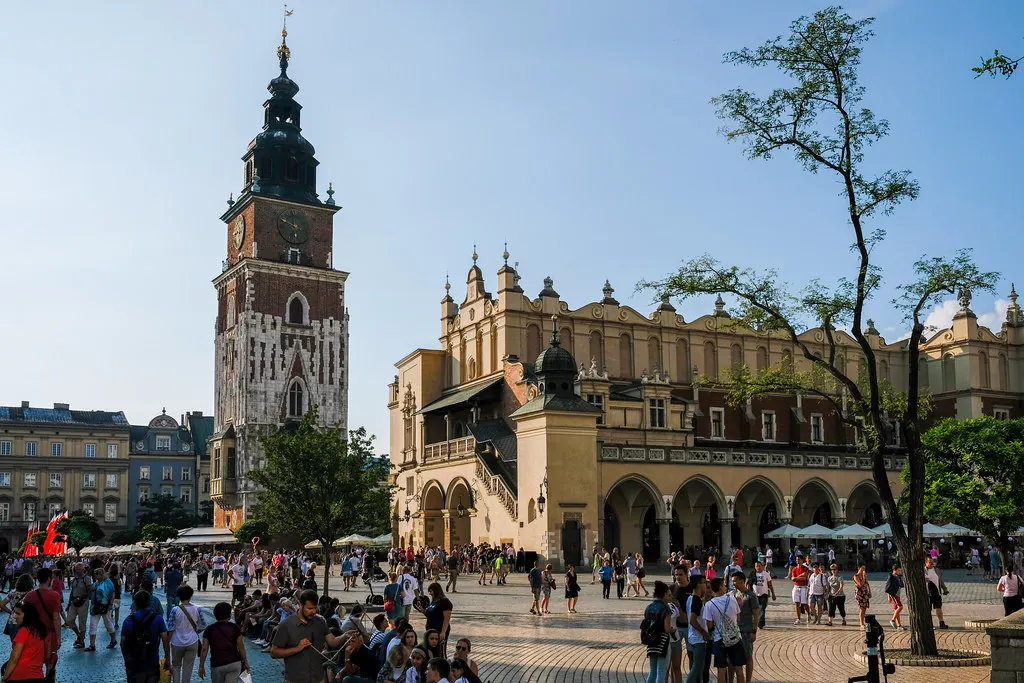
Poland began two days of national mourning after a gunman killed six people in the Main Square of Krakow's Old Town. Investigators found three additional bodies, identified as the suspect's family members, at a home around 150 kilometers northeast of Krakow. Police arrived at the scene 23 seconds after the first emergency call.
The attack left several people injured, including horse-drawn carriage drivers and two police officers who confronted the gunman. Two officers, Jakub Kulik and Artur Morański, were injured while pursuing and detaining the perpetrator. A local surgeon noted that immediate first aid helped save an officer's life during the intervention.
Interior Minister Marcin Kierwinski stated that everything indicates the suspect was inspired by far-right ideologies. Prime Minister Donald Tusk praised the officers for disregarding risks to save human lives, while Justice Minister Waldemar Żurek noted their actions prevented further casualties. Poland's interior minister also described the suspect as a 25-year-old Polish citizen, while other reports noted the suspect is 24 years old.
What each side says
Polish Government
“Everything indicates that he was fascinated by far-right ideologies”Marcin Kierwinski
Medical Professionals
“Without protection, without gloves, he simply focused on the officer, stopping the bleeding in his chest. This probably saved his life.”Mateusz Pędziwiatr
Who is involved
Marcin Kierwiński
Polish Minister of Internal Affairs and AdministrationIn this storyMarcin Kierwiński described the suspect as a 25-year-old Polish citizen inspired by far-right ideologies2.
Donald Tusk
Prime Minister of PolandIn this storyDonald Tusk stated that officers who were injured while pursuing and detaining the gunman probably saved many human lives4.
Waldemar Żurek
Minister of Justice and Prosecutor General of PolandIn this storyWaldemar Żurek stated that the actions of responders prevented further human casualties.
How we got here
- 2026-11-07A gunman opened fire in central Krakow, killing six people.
- 2026-11-08Poland began two days of national mourning.
What the research says5 studies, 2017–2023
This literature review provides an overview of the existing research and background context concerning firearms availability, violence, and policing in Europe, as well as general definitions of mass shootings. Understanding these foundational studies helps contextualize recent violent events without drawing new conclusions or taking sides. The review is organized into historical definitions of mass firearms incidents, systematic analyses of European gun violence and legislation, and criminological research regarding the policing and detection of firearms crime across European jurisdictions.
Definitions of Mass Shootings
Background definitions describe a mass shooting as a crime where one or more attackers use guns to kill or injure multiple individuals in rapid succession, which constitutes a form of mass murder when multiple victims are deceased6. Different organizations utilize varying criteria, as there is no widely accepted specific definition for the term6,7.
Such incidents generally feature the targeting of victims outside a combat setting and typically exclude gang violence, shootouts, and self-defense6. Perpetrators of ongoing attacks are often referred to as active shooters6. In the United States, research by Newman and Hartman (2017)8 examined public mass shootings and public support for gun control, while Webster et al.
(2020)9 analyzed the regulation of firearms design, sale, and carrying on fatal mass shootings using data from the Federal Bureau of Investigation's Supplemental Homicide Reports from 1984 to 2017. These studies collectively establish the foundational terminology used to categorize public firearm violence.
Firearms Violence in Europe
Prior research has investigated the relationship between firearm availability and interpersonal violence. Krüsselmann et al. (2021)10 conducted a systematic review in PLoS ONE noting that while higher availability of firearms has been connected to higher rates of interpersonal violence, previous studies focused mainly on the United States or used aggregated international data. To address whether aggregated findings apply to continental Europe, Krüsselmann et al.
(2021)10 searched nine databases to compile studies exclusively using European data. Complementing this, Bijleveld (2023)11 in the European Journal of Criminology highlighted that European criminology faces a lack of sufficient pan-European data, noting that while the European Sourcebook provides synchronized criminal justice system statistics, crime incidence data remain patchy because fewer countries conduct victimization surveys and methodological differences hinder cross-country comparisons11.
Policing Gun Crime in Europe
The enforcement and regulation of firearms have also been examined from a legislative and operational perspective. Hellenbach et al. (2017)12, writing in the European Journal of Criminology, observed that despite a shared understanding across the European Union that general public access to firearms should be restricted, detailed legislation concerning ownership, use, and trade varies between member states.
To determine how stakeholders perceive the impact of these legislative variations on the policing of gun-enabled crime within and across EU countries, Hellenbach et al. (2017)12 gathered qualitative data from interviews with police, policy, and decision-makers across 13 European countries. Their analysis identified four main themes, including disparities in legislation that present challenges to the effective detection and policing of gun crime in Europe12.
The reviewed literature demonstrates a significant methodological gap regarding pan-European data consistency, as noted by Bijleveld (2023) [11], who points out that victimization surveys and crime incidence data remain patchy and incomparable across European countries. Furthermore, Krüsselmann et al. (2021) [10] observed that earlier research on firearms availability and interpersonal violence focused predominantly on the United States, leaving questions about how continental European findings specifically compare. Additionally, while Hellenbach et al. (2017) [12] identified legislative disparities across 13 European nations through qualitative stakeholder interviews, the literature does not yet fully resolve how these varying national laws directly impact specific local operational responses during active firearm incidents.
European Criminology needs European Data: The case for a pan-European crime and victimization survey
Catrien C. J. H. Bijleveld · European Journal of CriminologyWhat to watch
- Further police investigations into the suspect's background and motives
- The conclusion of the two days of national mourning
Update to an ongoing story. Follow this story over time: What are the details of the mass shooting in Krakow, Poland? — living research page →
The data
Poland Real GDP Growth Ranking
Poland: 3.7%, 90 of 195 countries (median 3.5%).
IMF World Economic OutlookDownload data (CSV, opens in Excel)
Show the numbers (195)
Indicator: real GDP growth · Year: 2025 · Source: IMF World Economic Outlook
| Rank | Country | Value |
|---|---|---|
| 1 | South Sudan | 41.4 |
| 2 | Guyana | 19.3 |
| 3 | Libya | 15.9 |
| 4 | Kyrgyzstan | 11.1 |
| 5 | Rwanda | 9.4 |
| 6 | Ethiopia | 9.2 |
| 7 | Venezuela | 9 |
| 8 | Taiwan Province of China | 8.8 |
| 9 | Tajikistan | 8.4 |
| 10 | Zimbabwe | 8.3 |
| 11 | Bhutan | 8.2 |
| 12 | Benin | 8.1 |
| 13 | Ireland | 8 |
| 14 | Vietnam | 8 |
| 15 | India | 7.8 |
| 16 | Uzbekistan | 7.7 |
| 17 | Georgia | 7.5 |
| 18 | Armenia | 7.1 |
| 19 | Guinea | 6.9 |
| 20 | Niger | 6.9 |
| 21 | Mongolia | 6.8 |
| 22 | Senegal | 6.7 |
| 23 | Uganda | 6.7 |
| 24 | Paraguay | 6.6 |
| 25 | Côte d'Ivoire | 6.5 |
| 26 | Kazakhstan | 6.5 |
| 27 | Aruba | 6.3 |
| 28 | Cabo Verde | 6.3 |
| 29 | Maldives | 6.3 |
| 30 | Togo | 6.3 |
| 31 | Papua New Guinea | 6.2 |
| 32 | United Arab Emirates | 6.2 |
| 33 | Ghana | 6 |
| 34 | Palau | 6 |
| 35 | Tanzania | 5.9 |
| 36 | Central African Republic | 5.8 |
| 37 | Guinea-Bissau | 5.8 |
| 38 | Seychelles | 5.8 |
| 39 | Democratic Republic of the Congo | 5.7 |
| 40 | The Gambia | 5.7 |
| 41 | Burkina Faso | 5.3 |
| 42 | Cambodia | 5.3 |
| 43 | Malaysia | 5.2 |
| 44 | Tuvalu | 5.2 |
| 45 | Chad | 5.1 |
| 46 | Indonesia | 5.1 |
| 47 | Liberia | 5.1 |
| 48 | China | 5 |
| 49 | Singapore | 5 |
| 50 | Sri Lanka | 5 |
| 51 | Djibouti | 4.9 |
| 52 | Eswatini | 4.9 |
| 53 | Mali | 4.9 |
| 54 | Morocco | 4.9 |
| 55 | Nicaragua | 4.9 |
| 56 | Grenada | 4.8 |
| 57 | Laos | 4.8 |
| 58 | Sierra Leone | 4.8 |
| 59 | Macao SAR | 4.7 |
| 60 | Malta | 4.7 |
… 135 more rows in the CSV
IMF World Economic Outlook (IMF data, reused with citation)
Background
At a glance
 Poland
- Capital
- Warsaw
- Population
- 36.5 million
- Leaders
- Karol Nawrocki · Donald Tusk
- Currency
- złoty
Wikidata · IMF, 2026-11-09
Sources and method
References (18)
News reports
- How the deadly shooting in Krakow unfolded BBC World
- Two police officers hailed as heroes for confronting Kraków gunman The Guardian World
Studies
- Benjamin J. Newman and Todd K. Hartman (2017). Mass Shootings and Public Support for Gun Control British Journal of Political Science
- Daniel W. Webster et al. (2020). Evidence concerning the regulation of firearms design, sale, and carrying on fatal mass shootings in the United States Criminology & Public Policy
- Katharina Krüsselmann et al. (2021). Firearms and violence in Europe–A systematic review PLoS ONE
- Catrien C. J. H. Bijleveld (2023). European Criminology needs European Data: The case for a pan-European crime and victimization survey European Journal of Criminology
- Mike Hellenbach et al. (2017). The detection and policing of gun crime: Challenges to the effective policing of gun crime in Europe European Journal of Criminology
Background
- Marcin Kierwiński Wikipedia
- Donald Tusk Wikipedia
- Waldemar Żurek Wikipedia
- Mass shooting Wikipedia
- Mass shootings in the United States Wikipedia
Reports used for this brief
- How the deadly shooting in Krakow unfolded BBC World
- Poland begins two days of mourning over Krakow shooting DW
- Poland in shock after 6 killed in Krakow far-right shooting France 24
- Two police officers hailed as heroes for confronting Kraków gunman The Guardian World
Data
- IMF World Economic Outlook IMF data, reused with citation
- World Bank, World Development Indicators CC BY 4.0
How this brief was made
Automated research by ZynoNews: trending topic detected across news, searches and Wikipedia; facts and statements from the reports listed; numbers computed from open data; checked automatically for numbers, sources, copying and neutrality. Version 1. 4 news reports from 4 outlets, 4 official datasets, 5 research studies and 5 background sources.
Cite this
For papers, reports and theses. ZynoNews articles keep their address; updates are listed with their date.
ZynoNews Desk. (2026, November 11). Krakow Main Square Shooting Leaves Six Dead as Poland Mourns Mass Attack. ZynoNews. https://zynonews.org/news/krakow-main-square-shooting-leaves-six-dead-as-poland-mourns-mass-attack-32d7ce