3.75-4 percent United States Federal Reserve leaves interest rates unchanged
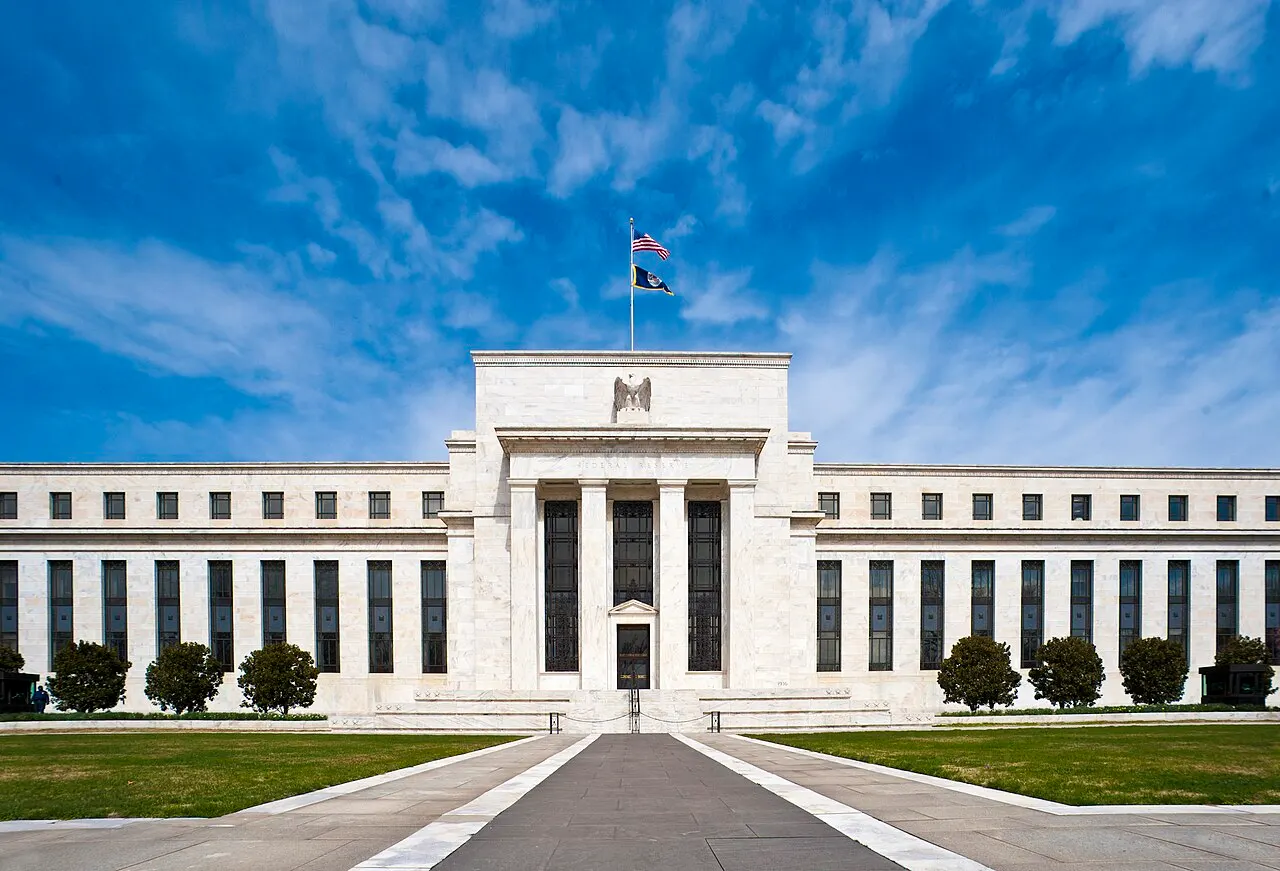
The US Federal Reserve maintained interest rates at 3.75 to 4 percent following a 10-2 vote.
At a glance
- The US Federal Reserve maintained interest rates at 3.75-4 percent following a 10-2 vote.
- The annual inflation rate in the US increased to 3.7 percent in September, up from 3.4 percent in August.
- The University of Michigan's Consumer Sentiment Index came in at 48.0 in October.
- Next: The Committee will gather more information to determine the policy stance appropriate to ensure a timely return of inflation to the 2 percent goal.
Drafted with AI from named sources and checked automatically; published by our AI editor after passing every check. How briefs are made
- Al Jazeera
- myanmarnews.net
- milwaukeesun.com
- akhbarlibya24.net
- economictimes.indiatimes.com
- 2news.com
The story
The US Federal Reserve maintained interest rates at 3.75-4 percent following a 10-2 vote. The annual inflation rate in the US increased to 3.7 percent in September, up from 3.4 percent in August.
The University of Michigan's Consumer Sentiment Index came in at 48.0 in October. Consumers expect prices to rise 4.7 percent over the next year, up from 4.6 percent in September.
The Fed stated that economic activity is expanding at a strong pace. Meanwhile, US President Donald Trump said that interest rates in the United States should be 1% or less.
What each side says
US Government
“Economic activity is expanding at a strong pace”The Fed
Analysts
“Purchasing power continues to dominate consumer views of the economy”Joanne Hsu
Who is involved
Federal Reserve System
Central banking system of the United StatesIn this storyThe United States Federal Reserve maintained interest rates at 3.75 to 4 percent following a 10-2 vote3.
Michelle Bowman
Member of the Federal Reserve Board of GovernorsIn this storyMichelle Bowman participated in the 10-2 vote that maintained interest rates at 3.75 to 4 percent3.
What the research says5 studies, 1998–2016
This literature review provides an overview of the historical background and academic research surrounding the United States central banking system and monetary policy, establishing context for recent policy decisions regarding interest rates. The review examines the establishment of the central bank, the function of benchmark interest rates, and empirical studies analyzing inflation targets and low-interest-rate environments.
By tracing the evolution of these economic frameworks, this survey synthesizes existing literature to help students and researchers understand the mechanisms governing monetary policy before today's news.
Historical Foundations of the Federal Reserve
The Federal Reserve System serves as the central banking system of the United States, established on December 23, 1913, through the enactment of the Federal Reserve Act, following a series of financial panics that spurred the demand for central control over the American monetary system (According to Wikipedia's history of Federal Reserve1). Although it operates as an instrument of the United States government, the institution functions as an independent central bank due to structural insulation designed to prevent political interference (According to Wikipedia's history of Federal Reserve1).
Throughout its history, major economic events such as the Great Depression of the 1930s and the Great Recession of the 2000s prompted an expansion of the central bank's operational remit (According to Wikipedia's history of Federal Reserve1). Central banks utilize these structures to influence financial conditions and accomplish broader economic objectives, including high employment and price stability (According to Wikipedia's history of Monetary policy4).
Monetary Policy and Inflation Targets
Academic literature has extensively examined the behavior and measurement of central bank inflation targets over time. Peter N. Ireland (2007)5 estimated a New Keynesian model indicating that the Federal Reserve's unobserved inflation target rose from 1 and 1/4 percent in 1959 to over 8 percent in the mid to late 1970s, before declining back below 2 and 1/2 percent in 2004.
This research suggests that Federal Reserve policy systematically translated short-run price pressures from supply-side shocks into persistent movements in inflation during the post-war period, though substantial uncertainty remains regarding the true sources of these target shifts (Peter N. Ireland, 2007)5. Complementing this historical estimation, Glenn D. Rudebusch and Lars E.O. Svensson (1998)6 utilized a small empirical model of the United States economy to analyze policy rules consistent with an inflation-targeting regime, noting that explicit inflation targeting in other nations is characterized by publicly announced numerical targets and forward-looking forecast frameworks.
Operating at the Zero Lower Bound
When short-term nominal interest rates approach zero, monetary policy committees face unique challenges in communicating and conducting their policies, prompting significant research into unconventional measures (Ben Shalom Bernanke and Vincent Raymond Reinhart, 2004)7. To evaluate these conditions, Jing Cynthia Wu and Fan Dora Xia (2016)8 employed a nonlinear term structure model to analyze an economy operating near the zero lower bound, finding that Federal Reserve efforts to stimulate the economy after July 2009 successfully lowered the December 2013 unemployment rate by 1 percent.
Similarly, Leonardo Gambacorta et al. (2014)9 assessed the macroeconomic effects of unconventional monetary policies across eight advanced economies using a panel vector autoregression with monthly data, concluding that exogenous increases in central bank balance sheets lead to temporary increases in economic activity and consumer prices, with output effects qualitatively similar to conventional monetary policy.
While existing studies extensively examine historical inflation targets and unconventional monetary policy at the zero lower bound, the literature lacks consensus on the exact sources of shifts in the unobserved inflation target and the precise long-term persistence of price level impacts from balance sheet expansions. Furthermore, while models estimate the macroeconomic effects of past Federal Reserve interventions on unemployment and output, data measuring the specific psychological impacts of consumer sentiment indices and short-term inflation expectations on committee voting behavior remains limited within the surveyed academic corpus.
Measuring the Macroeconomic Impact of Monetary Policy at the Zero Lower Bound
Jing Cynthia Wu and Fan Dora Xia · Journal of money credit and bankingWhat to watch
- The Committee will gather more information to determine the policy stance appropriate to ensure a timely return of inflation to the 2 percent goal.
The data
Inflation ranking for the United States
United States: 2.7%, 108 of 195 countries (median 3%).
IMF World Economic OutlookDownload data (CSV, opens in Excel)
Show the numbers (195)
Indicator: inflation · Year: 2025 · Source: IMF World Economic Outlook
| Rank | Country | Value |
|---|---|---|
| 1 | Venezuela | 252 |
| 2 | Sudan | 99.9 |
| 3 | South Sudan | 97.6 |
| 4 | Zimbabwe | 81.4 |
| 5 | Iran | 50.6 |
| 6 | Argentina | 41.9 |
| 7 | Türkiye | 34.9 |
| 8 | Burundi | 34 |
| 9 | Malawi | 28.4 |
| 10 | Haiti | 28.3 |
| 11 | Nigeria | 23 |
| 12 | Myanmar | 21.1 |
| 13 | Egypt | 20.4 |
| 14 | Angola | 20.2 |
| 15 | Yemen | 20.2 |
| 16 | Bolivia | 19.5 |
| 17 | Ethiopia | 16 |
| 18 | Lebanon | 14.6 |
| 19 | Ghana | 14.2 |
| 20 | Zambia | 13.9 |
| 21 | Ukraine | 12.7 |
| 22 | Kazakhstan | 11.4 |
| 23 | West Bank and Gaza | 10.5 |
| 24 | Bangladesh | 10 |
| 25 | Suriname | 9.2 |
| 26 | Uzbekistan | 8.8 |
| 27 | Russia | 8.7 |
| 28 | Mongolia | 8.6 |
| 29 | Liberia | 8.3 |
| 30 | Kyrgyzstan | 8.2 |
| 31 | Madagascar | 8 |
| 32 | The Gambia | 7.9 |
| 33 | Moldova | 7.8 |
| 34 | Laos | 7.7 |
| 35 | Sierra Leone | 7.6 |
| 36 | Democratic Republic of the Congo | 7.4 |
| 37 | Romania | 7.3 |
| 38 | Rwanda | 7 |
| 39 | Belarus | 6.6 |
| 40 | Naoero | 6.1 |
| 41 | Kiribati | 5.9 |
| 42 | Azerbaijan | 5.6 |
| 43 | Tunisia | 5.3 |
| 44 | Colombia | 5.1 |
| 45 | Brazil | 5 |
| 46 | Estonia | 4.8 |
| 47 | Uruguay | 4.7 |
| 48 | Honduras | 4.6 |
| 49 | Pakistan | 4.5 |
| 50 | Croatia | 4.4 |
| 51 | Hungary | 4.4 |
| 52 | Mozambique | 4.4 |
| 53 | Papua New Guinea | 4.4 |
| 54 | Chile | 4.2 |
| 55 | Slovakia | 4.2 |
| 56 | Iceland | 4.1 |
| 57 | Kenya | 4.1 |
| 58 | Marshall Islands | 4.1 |
| 59 | Nepal | 4.1 |
| 60 | North Macedonia | 4.1 |
… 135 more rows in the CSV
IMF World Economic Outlook (IMF data, reused with citation)
How the world is covering it
7 reports from 4 countries in 2 languages in the last three days.
Coverage data: GDELT Project
Background
At a glance
 United States
- Capital
- Washington, D.C.
- Population
- 341.9 million
- Leaders
- Donald Trump
- Currency
- United States dollar
Wikidata · IMF, 2026-10-29
Sources and method
References (16)
News reports
Studies
- Peter N. Ireland (2007). Changes in the Federal Reserve's Inflation Target: Causes and Consequences Journal of money credit and banking
- Glenn D. Rudebusch and Lars E.O. Svensson (1998). Policy Rules for Inflation Targeting National Bureau of Economic Research
- Ben Shalom Bernanke and Vincent Raymond Reinhart (2004). Conducting Monetary Policy at Very Low Short-Term Interest Rates American Economic Review
- Jing Cynthia Wu and Fan Dora Xia (2016). Measuring the Macroeconomic Impact of Monetary Policy at the Zero Lower Bound Journal of money credit and banking
- Leonardo Gambacorta et al. (2014). The Effectiveness of Unconventional Monetary Policy at the Zero Lower Bound: A Cross‐Country Analysis Journal of money credit and banking
Background
- Federal Reserve Wikipedia
- Michelle Bowman Wikipedia
- Monetary policy Wikipedia
Reports used for this brief
- Fed leaves interest rates unchanged despite inflation in the US Al Jazeera
- US consumer sentiment near record low as inflation fears persist myanmarnews.net
- US consumer sentiment stays near record low in October milwaukeesun.com
- ارتفاع النفط يضغط على اليورو والدولار يستفيد من ترقب الأسواق akhbarlibya24.net
- Global Market : China yuan hits four - year high as dollar weakens ahead of policy meetings economictimes.indiatimes.com
- Shares fall in Asia after a decline on Wall Street , and oil prices fall more than 1 % 2news.com
Data
- IMF World Economic Outlook IMF data, reused with citation
How this brief was made
Automated research by ZynoNews: trending topic detected across news, searches and Wikipedia; facts and statements from the reports listed; numbers computed from open data; checked automatically for numbers, sources, copying and neutrality. Version 1. 6 news reports from 6 outlets, 3 official datasets, 5 research studies and 3 background sources.
Cite this
For papers, reports and theses. ZynoNews articles keep their address; updates are listed with their date.
ZynoNews Desk. (2026, October 29). United States Federal Reserve leaves interest rates unchanged. ZynoNews. https://zynonews.org/news/united-states-federal-reserve-leaves-interest-rates-unchanged-e18844